
Time to Displacement
A Model for Measuring When AI Threatens Your Business
It’s been a few months of experimentation to land on a Time to Displacement Model. It can take a business and estimate its own AI displacement clock, in years.
This is not a prediction that a company fails on a given date, but an estimate of when the competitive conversation changes. Before the displacement point, your customers are choosing between you, your competitors, or the traditional way of doing things. After it, they are choosing between you and AI-powered alternatives that did not exist before. The number marks the line between those two periods.
A Response to Canada's Six AI Pillars
Canada's Spring Economic Update introduced "Artificial Intelligence for All," a six-pillar strategy drawn from 11,000 submissions. The pillars are well chosen. The harder question is whether they can move at the same speed.
This response works through each pillar from an executive perspective. The pillars are right. They are also in tension. Adoption decisions move on quarterly horizons. Skills systems update on multi-year cycles. Protective infrastructure runs on procurement timelines that predate AI. Compute and capital move on horizons longer still.
A strategy is not a list of objectives. It is a sequencing decision under constraint. These pillars will not be judged on whether they were right, but on whether the strategy held them together when the speeds diverged.
The Hidden Dependency
The Hidden Dependency
Every business depends on three external systems: a labour market that produces skilled workers, a consumer base with stable income, and institutional trust that supports long-term planning. AI is acting on the first of these in a way most executives have not yet priced in. Hiring of workers aged 22–25 in AI-exposed occupations has slowed sharply, and Stanford's Canaries in the Coal Mine research shows a near twenty percent decline among young software developers since 2022. The structure is still standing, but the entry floor is being removed. The front door is narrowing before the building shakes. Paper 03 examines what executives can control when the system their business quietly runs on begins to restructure beneath them.
Reading the Stanford AI Index 2026 Against the Canary Papers
Employment for US software developers aged 22 to 25 has fallen nearly 20% from its 2022 peak.
Headcount for older developers keeps growing.
That finding sits in Stanford's AI Index 2026, published this week. 423 pages of independent data on where AI stands.
The alignment is closer than I expected when looking at the full report against the first two Canary Papers.
"Jagged intelligence" is now a headline Stanford finding, not a metaphor: Gemini Deep Think won gold at the 2025 International Mathematical Olympiad; the same class of models reads analog clocks correctly 50% of the time.
Access has outrun integration. 88% of organizations use AI in at least one function. Agent deployment sits in single digits. The United States ranks 24th globally in population-level adoption despite leading on every other measure.
The structure is still standing. The doorways are getting smaller.
The Rate of AI Diffusion
On the Distance Between Capability and Adoption
AI reached a hundred million users in two months. But access isn't integration. New research from Anthropic reveals that in computer and math roles, AI could theoretically handle 94% of tasks, yet actual usage covers just 33%. Most organizations remain stuck at the shallowest layer of adoption: bolting AI onto individual tasks without redesigning workflows, functions, or offerings. The gap between what AI can do and what organizations are doing with it is the defining feature of this moment. Edison's first customers had electric light in 1882. The redesigned factory took decades. The same pattern is playing out now, only faster.
A Century in a Decade: What Corporate Survival Really Tells Us About the AI Era
A Century in a Decade: What Corporate Survival Really Tells Us About the AI Era
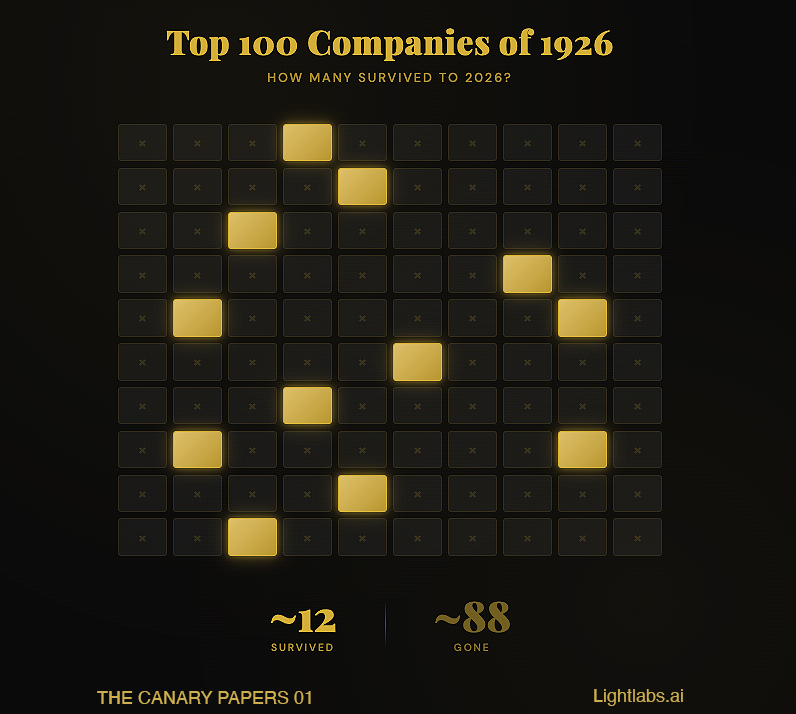
Take your best guess: how many of the top 100 U.S. companies from 1926 are still in operation today?
Not a descendant. Not a brand that got absorbed into something else. Not a ticker symbol that survived through five mergers and a name change. The actual company, recognizable purpose, continuous identity, still standing on its own.
The answer is about 12.
A Century in a Decade
What happens if capability improves faster than organizations, workflows, and leadership teams can adapt?
Not prediction.
Not hype.
A discipline of seeing clearly.
This first paper examines:
why the gap between AI capability and organizational adoption may become the real story
why cheap cognition changes the shape of firms
why judgment, trust, relationships, and domain knowledge become more valuable, not less
why diffusion, resistance, and organizational friction may matter as much as the technology itself

AI Policy and Guidelines - An Outline For Your Business.
As we navigate the integration of artificial intelligence into our operations, it is essential to establish a governance framework that balances innovation with responsibility. These Draft AI Guidelines serve as a strategic starting point for your internal discussion, proposing nine core pillars that range from ensuring purposeful, value-aligned use to maintaining strict standards for privacy and data protection.

How to Chart and Navigate an AI Roadmap for Your Business.
In an era where unpredictability is the only constant, leadership requires trading rigid maps for evolving strategies that prioritize deep executive capacity and cultural readiness over mere technology. This guide charts a six-step evolution from initial policy to fully AI-enabled operations, proving that the surest route to value lies not in saving time, but in redefining process.

The GPT-5 Agent Dilemma: Credentials, Credit Cards, and the Cost of Convenience
OpenAI’s new GPT-5 Google integrations mark a shift in capacity where AI agents can act like true executive assistants, accessing email, calendars, and contacts to automate work, but they also force us to confront the risks of handing over deep personal data, credentials, and eventually financial access in exchange for unprecedented convenience.

The Rise of AI Agents: From Assistants to Autonomous Workers
AI agents are rapidly evolving from simple assistants to autonomous systems capable of planning and executing complex workflows independently.

The Intelligence Abundance Era
The global economy is transforming from intelligence scarcity to abundance as AI democratizes cognitive capabilities at near-zero marginal cost, requiring executives to reimagine workforce architecture, accelerate knowledge infrastructure, and build AI governance to capture value in this new paradigm.

Your Super Prompt for Business
This is your super prompt for business to get meaningful and useful results.

The AI Infrastructure Arms Race. Key Takeaways.
A strategic analysis of the unprecedented trillion dollar global AI infrastructure buildout and its implications for enterprise competitiveness in an era where computational capacity determines innovation velocity.

The U.S.-China AI Race: Strategic Implications for Business
The U.S.-China AI competition is reshaping global technology access, with control over semiconductors and energy infrastructure becoming critical determinants of competitive advantage that executives must navigate through strategic risk planning.

Navigating the AGI-ASI Frontier: What Executives Need to Know
This blog examines the race among leading AI labs to develop Artificial General Intelligence (AGI) and Artificial Super Intelligence (ASI), explaining the critical distinctions between these concepts and their strategic implications for business leaders

The Physical AI Revolution: Robot Advancements
The simultaneous breakthroughs across 20+ AI and robotics laboratories in late 2024 signal that physical AI systems are rapidly transitioning from experimental technology to operational reality, demanding immediate strategic attention from executive teams despite a 2-3 year horizon before widespread enterprise deployment.